
 Google Scholar
About
Bio
I’m an ML Product Leader with 20+ years of experience building AI systems at scale, from research to production. My work sits at the intersection of machine learning, personalization and human-computer interaction, with a particular focus on the gap between models theory and actual experiences.
Most recently I spent nearly five years at Meta as a Principal PM (IC7), leading the ML platform for long-form video and Reels ranking at billion-user scale, migrating training and inference from CPUs to GPUs and driving early-stage candidate retrieval across 80+ billion videos. After that I led AR smart glasses input performance at Reality Labs where I created human-centric evaluation frameworks that replaced naive F1 metrics with task-based benchmarks. I hold three issued patents on implicit user modeling (633 citations by Google, Microsoft, Amazon, Palantir, Facebook, eBay, Yahoo!, IBM, Walmart, Salesforce and others) and a Stanford Graduate Certificate in AI. I also TA in Stanford’s AI Professional Program (see below).
Earlier, I founded Rank Dynamics, where I built and commercialized “dynamic ranking,” real-time implicit personalization for web search, scaling it to $10M in revenue, 12M browser extension downloads and 5M DAUs. That experience convinced me that the best personalization is invisible: systems that learn from what users do, not what they say.
That conviction is driving my current side project. I’m building mymemochat.com, an LLM personalization prototype that extracts preference signals from natural conversation, embeds them, clusters them using DBSCAN, applies configurable memory decay and injects them back into the context window via prompt injection, with RAG-based retrieval as the planned evolution, all without prompting users about themselves. I’m writing about the architecture and design decisions in my LLM Personalization blog.
When I’m not thinking about AI, I’m building Mortal Wayfare, a turn-based RPG for Android that I wrote from scratch, engine and all, in ~15,000 lines of Java across 175 files. No Unity. No Unreal. Custom rendering on SurfaceView, precomputed line-of-sight with bitwise symmetry unfolding, A* pathfinding with horizon clipping, inverse-square torch illumination with flicker, and Pathfinder combat rules encoded directly into data structures. The game also has a significant amount of AI built into it. There’s a battle simulation mode designed for RL data collection already in there and teaching combatants to operate optimally via RL is next on the list. After a five-year hiatus, I recently revived the project with Claude Code, which has dramatically accelerated the pace. It might sound like a silly side project, but building it was my path into object-oriented programming, which eventually unlocked Python, ML and everything that followed.
The rest of this blog documents the experiments, prototypes and rabbit holes that don’t fit neatly anywhere else. If you’d like to learn more, my social media links are to the left.
Contact
You may book an appointment with me using Calendly. If we’re not already connected, the best way to find me is probably on LinkedIn. The “book an appointment” button will bring you back here.
I offer 1-on-1 advice for folks interested in learning about Product Management. Here are two articles to check out before we chat:
I also do entrepreneurial advising and mentoring through the MIT Alumni Advisors Hub.
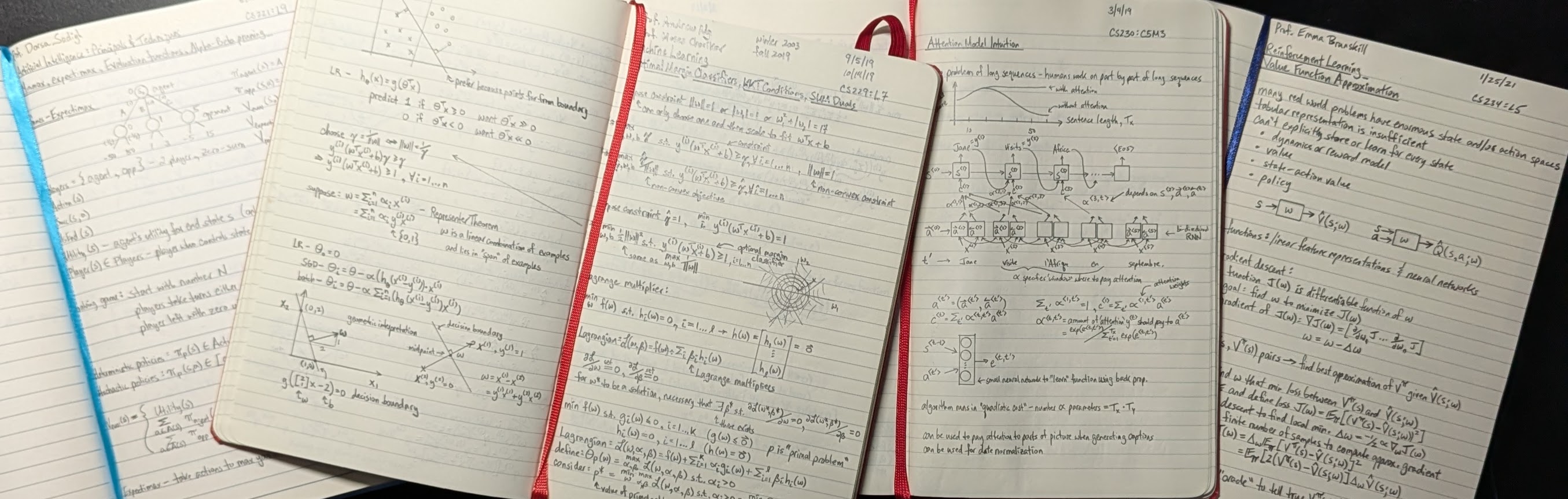
Lastly, as Teaching Assistant for xcs221 - AI Principles and Techniques, xcs234 - Reinforcement Learning and xcs229 - Machine Learning, Andrew Ng’s famous foundational course, at Stanford’s AI Professional Program, I make appointments available to students in my cohorts.
Fun stuff
Here I’ll put some random stuff about my personal life
Leave a Comment